

On this page
ROC organizes its collateral into two coordinated buckets, or separate accounting compartments for collateral assets. Each bucket keeps track of its collateral, its attributed USDRIF liabilities and its operational limits. Together they support the same USDRIF token.
Two collateral assets, one stablecoin
| Bucket | Asset deposited as collateral | Stablecoin issued |
|---|---|---|
| RIF | RIF | USDRIF |
| DOC | Dollar On Chain (DOC) | USDRIF |
RIF is a volatile asset. Its bucket requires a collateral buffer, supported by the residual value represented by RIFP. DOC is a USD-pegged stablecoin issued by Money On Chain. Its bucket has a different coverage model because the collateral itself targets the US dollar.
USDRIF is fungible regardless of which bucket issued it. You can request redemption into either supported collateral asset, subject to the selected bucket’s attributed USDRIF liabilities and operational limits. Your USDRIF balance alone does not establish how much can be redeemed from a particular bucket.
Read the dashboard
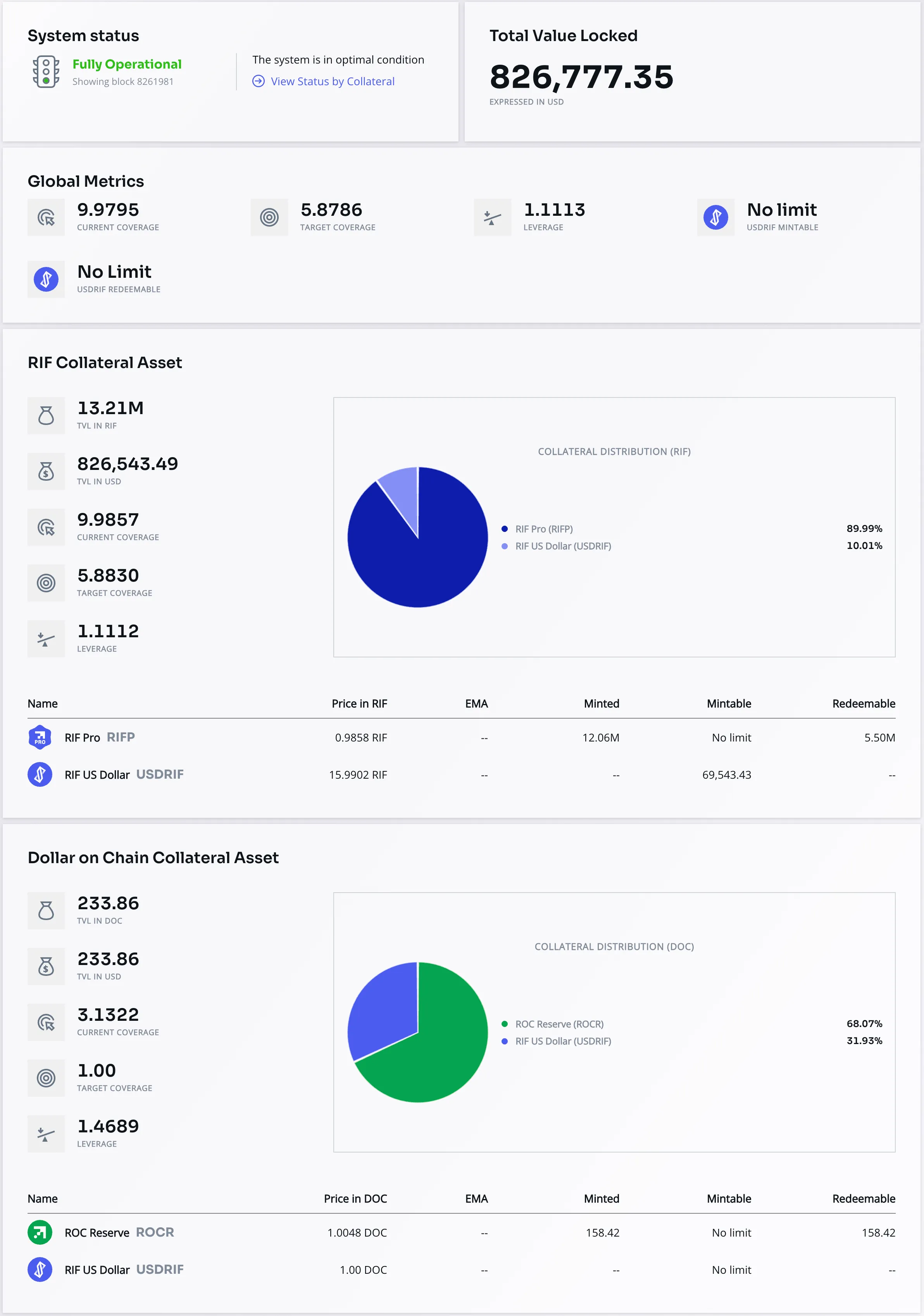
Illustrative interface snapshot. Prices, balances, coverage, limits and distributions are not live values.
Global Metrics summarizes the system. RIF Collateral Asset and Dollar on Chain Collateral Asset show each bucket separately. Check current and target coverage, mintable and redeemable amounts, and collateral distribution in the relevant bucket.
A coverage ratio compares collateral value with the bucket’s USDRIF liabilities. The RIF bucket is designed to operate with a larger buffer than the DOC bucket. A global “No limit” label is not a promise of unlimited execution for every pair, amount or bucket.
RIFP absorbs the RIF bucket’s residual risk
USDRIF has priority over the residual claims represented by RIFP in the RIF bucket. RIFP’s value depends on the collateral left after accounting for USDRIF liabilities. RIFP is not a stablecoin and does not guarantee a return.
The protocol includes stabilization mechanisms that can reallocate liabilities and collateral between buckets under specified conditions. DOC collateral also introduces exposure to the functioning and backing of Money On Chain; its peg should not be treated as risk-free.
Choose the right flow
The guide covers both buckets and explains how the available selectors depend on the interface configuration.
Availability in the dApp
In Exchange, you can mint USDRIF with RIF or DOC and redeem it for the selected collateral, subject to bucket limits. The Combined Operations flows described in this guide use RIF, USDRIF and RIFP.
In the RIF bucket, standalone USDRIF issuance uses coverage capacity. Combined minting provides the collateral corresponding to both tokens you receive: USDRIF and RIFP. From the USDRIF amount you enter, the protocol calculates the RIFP to mint and the total collateral needed to maintain the bucket’s coverage.
In a combined redemption, you send RIFP together with the USDRIF amount calculated by the protocol and receive the collateral corresponding to both tokens. Burning both reduces collateral and liabilities in the proportion needed to maintain the bucket’s coverage. This can allow a RIFP redemption that would not meet coverage requirements individually.
Read an operation from start to finish
On Rootstock Mainnet (chain ID 30), connect a compatible wallet with the input assets and rBTC for gas. In Exchange, DOC → USDRIF deposits DOC and mints USDRIF; USDRIF → DOC burns USDRIF and withdraws DOC. RIF → USDRIF and its reverse use the RIF bucket.
For combined minting, open Combined Operations, select RIF and enter the desired USDRIF amount. The application calculates the RIFP output and total RIF input. To redeem, select RIFP, enter its amount and review the USDRIF required alongside it and the RIF returned.
Review amounts, protocol fees, Price Variation Tolerance and available limits. Approve each input token if requested, then confirm Exchange and the wallet transaction. Approval and submission are separate steps. A queued request has not executed yet: check Last Operations through final execution and verify balances. Network gas and execution costs require rBTC, even with a zero protocol fee.